Wednesday, August 29, 2018

Spiritual Betrayal: A Reflection

"But woe to you, scribes and Pharisees, hypocrites! For you lock people out of the kingdom of heaven. For you do not go in yourselves, and when others are going in, you stop them. Woe to you, scribes and Pharisees, hypocrites! For you cross sea and land to make a single convert, and you make the new convert twice as much a child of hell as yourselves." Mathew 23:13-15 

      Over my time involved in the Church, I have faced conflicts and wrongs with other members of the Church. Such is life. I have disappointed others, and I have been disappointed. Where I have disappointed others, I think I have been prompt in apologizing and build bridges that were once burnt. But though I myself am in need of much repentance, I seek to express being disappointed here. Such is life that we face conflicts and disappointments. But some wrongs committed by the Church hierarchy came to light, the ones that ought to be outside of the norms contained within the common phrasing "such is life."

     When it comes to disappointments, I have gradually learned to turn the other cheek and be merciful toward those who are disloyal, those who seek to put me down with their secular power, those who are prejudicial, those who are jealous, those who tolerate heterodoxy, those who despise corrections, those who do not like to be criticized of their inadequacies. Countless times have I ignored gossips, countless times have I tolerated passive-aggressive statements by community members, countless times have I tolerated false accusations, countless times have I pretended to not know of the complaints said about me. Countless times have I simply greeted them with a smile as if I were oblivious to the wrongs they committed against me. Though I fail oftentimes, I have learned to quickly calm my anger and admit my wrongs where there were. I then seek to correct their paths either through example or through more subtle methods. But when it comes to betrayals, I must speak out and scold them. Subtlety has no place in correcting betrayals for it is among the gravest of wrongs. After all, Dante places traitors at the last circle of hell.

     Theirs is a spiritual betrayal. They placed themselves in positions of power and placed themselves in our lives to be trusted. To become fathers for the fatherless, friends for the friendless, listening ears for the downtrodden, and physical reflections of Christ's virtue. Such are the duties of priests in Catholic communities. Yet they exploited the vulnerability of our youth, took advantage of the secrecy of confessions, made homosexuality into a currency to bargain over, and ridiculed those other faithful priests and laypeople who sought to restore reverence in the liturgy and correct heresies.

     I have known betrayal. Such is life. But never have I felt so betrayed, so offended, so enraged. Perhaps it is because it is the words of these men who I feel betrayed by I turned toward to gain wisdom, to learn how to suffer through betrayals and other wrongs committed against me. It is in this sense of indignation I write this in criticism of these men I feel betrayed by... of these men millions feel betrayed by. I wonder... did they feel a sting in their hearts when they read the gospel reading for the 27th?

     The aim here is to express my thoughts as to the root of the problem, on why and how the scandal has occurred. The root is spiritual decay. Modern paganism in its idiocy seeks to divorce spirituality from moral life. This is not so. When one is weak in spirit there will be falls in moral dispositions. This is why the Church hierarchy has failed in such a spectacular and wretched fashion.

..."The Bishops in the Unites States must not be ideologized, they must not be right-wing...and they must not be left-wing." 

     The quote above, on its face value, has much wisdom. When it comes to the teachings of the Church, there is no such thing as right-wing or left-wing, conservative or liberal. They are but misnomers extracted from petty secular politics to loosely characterize positions within the Church. Without these euphemisms, the two sides of the Church can be characterized in two terms: those who are orthodox in faith and those who are unorthodox in faith. The mere fact that the latter side exists brings about spiritual decay and thereby instigating moral decay.

"Many of the Jesus' disciples were listening and said, 'This saying is hard; who can accept it?' Since Jesus knew that his disciples were murmuring about this, he said to them, 'Does this shock you?'" - John 6:60-61

     For I know the prevalence of those priests, bishops, and cardinals who tolerate heterodoxy, I am not on some level surprised by how systematic the network of abusive priests was. We live in the most heretical age. We are being led by a generation of priests who care not for sound doctrine, who justify all sorts of liturgical and doctrinal deviancy through Vatican II. We are being led by a generation of priests and other lay leaders who ridicule and put down faithful priests and laypersons that seek to restore spiritual health of the Church as being "rigid" and "radical." Fools. It is they who refuse to aggressively restore spiritual health of the Church are the ones rigid in their prideful ways and radical in their inaction. Those with the gift of discernment have forflong been seeing legions surrounding the clergymen under fire now. It is foolish to think that those accused priests come primarily from unorthodox diocese by mere chance. Now we know them by their fruits, and the faithful must begin to see them by their fruits.

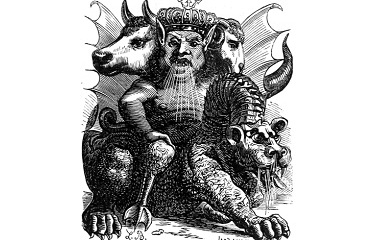
     Those who are unorthodox in faith tolerate heterodoxy and heresy. In so doing they spawn sacrileges against the sacraments, a sure sign of spiritual decay. From defiling of the sacraments, they spawn moral failures. Christians like to repeat as if it were a mantra: sacraments are the pinnacle of Christian life. When these sacraments are defiled, then, the deviancy would naturally trickle down, corrupting one's moral life also. They do not know how to read the spiritual winds. They do not know how there are invisible forces moving against the Church and those who try to restore the Church. A tiny manipulative whisper from a mere fledgling of a demon worthy only of being depicted in cartoons is enough to send them spiraling down to moral lows.

"For the time is coming when people will not put up with sound doctrine, but having itching ears, they will accumulate for themselves teachers to suit their own desires." - 2 Timothy 4:3 

     The "deviant wing" of the Church only speaks of things people feel good about. Love others, they so boldly proclaim. As if they know what it means to love! All they do is indulge people, regardless of their moral states.Build bridges, they so boldly claim. As if they know what it means to understand others! They brush aside those who are orthodox in faith like vermin. I say of these men: They do not know true Christian love. If they did, they would have actively taken steps to correct heresies and moral failures committed by the faithful. If they did, they would have denied sacraments those those who give out their conscience to immoral things, not out of desire to discriminate, but out of desire to prevent others from committing sacrileges.

"Remember then from what you have fallen; repent, and do the works you did at first. If not, I will come to you and remove your lampstand from its place, unless you repent. Yet this is your credit: you hate the works of Nicolaitans, which I also hate." - Revelations 2:5-6

     They wonder why the Church is losing people. They seek to attract people by hiding true doctrine and removing reverence from the liturgy. They are fools. Those who seek religion are looking for the otherworldly, not the worldly. They care not for hard doctrines insofar as the spiritual reward is great.

     The modern Church is like that of a lampstand that is flickering. Christ through His messenger in clearly tells us in Revelation that widespread heresy (Nicolaitans) will result in lessening of its members by having them removed among the lampstands at the altar of God.

     Perhaps you are one among those who are not orthodox in faith. Perhaps you are one among those who tolerate heterodoxy and irreverence. Perhaps you feel offended by my words. If you do, I expect that it is not the first time. Perhaps you feel challenged in your authority. Perhaps you feel the tendency to ridicule and to complain. I have merely spoken the same things I have been saying for years. I only pray that you do not spiral down to unrighteous indignation.

     Repent, then, you scribes and Pharisees, you who lead two out of three to be children of hell. Woe to them should you fail to do so. There is no shortage of other lampstands to replace them. It appears that it is necessary to make a complete clerical overhaul anyway.

"Ha! You who hide a plan too deep for the LORD, whose deeds are in the dark, and who say, "Who sees us? Who knows us? You turn things upside down! shall the potter be regarded as the clay? Shall the thing made say of its maker, "He did not make me"; or the thing formed say of the one who formed it "He has no understanding?" Isaiah 9:15-16  


Reform the Inquisition. Learn from the past mistakes. Root out the deviants. 

Monday, June 25, 2018

"Don Jon" Christianity

"Whoever, therefore, eats the bread or drinks the cup of the Lord in an unworthy manner will be guilty of profaning the body and blood of the Lord. Let a man examine himself, and so eat of the bread and drink of the cup. For any one who eats and drinks without discerning the body eats and drinks judgment upon himself. That is why many of you are weak and ill, and some have died."
 - 1 Cor. 11:27-30  


In the movie Don Jon starring Joseph Gordon-Levitt and Scarlett Johansson, the main character is a womanizing porn addict who has the temper of a lunatic. There are only few things he cares about in life: His body, his pad, his ride, his family, his church, his girls, and… his porn. He does seem to care a whole lot about the Church. He goes to a Catholic church every Sunday and he goes to confession every week. A whole lot more often than most Catholics. His confessions are always the same: consumption of pornography, masturbation, and fornication. But on his way to church, he would display a sort of malice that is unheard of among drivers, even in New Jersey. Yet such sins of malice go unmentioned in the confessional.

The movie is a raunchy movie filled with crude humor. But I recognized that there are good lessons to be extracted from the movie. It criticized how men are looking for one-sided relationships based on sexual satisfaction and how women are looking for similar one-sided relationships based on the desire to fill their narcissistic vanity by hunting for marriage as opposed to discerning marriage. But I saw another criticism in the movie: Just how underdeveloped Christian moral conscience currently is, and just how much it focuses on carnal sins when spiritual sins are of graver matter.

The movie, intentional or no, criticized how Christians (I suppose Catholics specifically in the context of the movie) are so attached to sexual sins that they fail to recognize other sins in their lives, that if they simply confess of their sexual sins, they have no other mortal sins to confess. Like Joseph Gordon-Levitt’s character, they are prone to not feel remorseful or even recognize acts like malice as a sin.

Consider the words of the great Doctor of the Church St. Thomas Aquinas: “Wherefore a sin which is about the very substance of man, e.g. murder, is graver than a sin which is about external things, e.g. theft; and graver still is a sin committed directly against God, e.g. unbelief, blasphemy, and the like: and in each of these grades of sin, one sin will be graver than another according as it is about a higher or lower principle.Summa Theologica Q73A3.

In expanding further, St. Thomas Aquinas notes that “Spiritual sins are of greater guilt than carnal sins.” Summa Theologica Q73A5. For spiritual sins are directed at the spiritual things, which are of higher order than the material things, they are of graver moral weight.

Note that the Scriptures affirm this view (if you believe that all sins are of equal weight, check John 19:11; Christ literally points out to who has the greater guilt). The original sin was not consumption of pornography, masturbation, or even fornication. The original sin was betrayal of God’s trust in Man and Woman, fueled by concupiscence corrupted by Pride The immediate proceeding sin committed by Adam was betrayal against Eve, accusing her of greater sin, playing the blame game. Where he ought to have maintained his loyalty for her and owned up to his wrongs, he offer her up to God in hopes of mitigating his own wrongs. In both betrayals, they are directed at spiritual, immaterial things that are of higher order than that of carnal, material things. Betrayal against God damaged the spiritual bond between humans and their Creator, and betrayal against spouse damaged the spiritual, intimate bond between a man and his wife.

Note also the fact that the creatures that are considered irredeemable and unable to be saved are Satan and his horde of demons. The reason they cannot be saved is because they are highly intellectual beings able to perceive of things atemporally, meaning they are able to see simultaneously the past, present, and the potential futures and know of the consequences of their betrayal against God. Despite knowing the consequences, they deliberately betrayed God. For they are without bodies to have carnal appetites, demons rendered themselves irredeemable through their sins of the intellect and the spiritual. Thus, their irredeemableness shows how the spiritual sins are of graver matter than carnal sins like how St. Thomas Aquinas said.

Dante’s Inferno paints for us the moral theology of Christianity through his imagination. In his vision of hell, the lower circles of hell punish sins of graver matter. The first circle is Limbo, where pagans who were virtuous and the sinless unbaptised reside. There is no particular punishment apart from being a lowered form of heaven. For their virtues they have received their award (the existence of Limbo is not doctrine).

The second circle of hell is for the lustful. The third circle of hell is for the gluttonous. Recognize here that Dante already exhausted all the carnal sins in the first two circles of “actual” hell. The fourth circle is greed, an expanded version of the two previous sins, but one that has great spiritual consequences.

Beyond the fourth circle, the separation between the carnal sins and the spiritual sins sharply divide. The fifth circle is for the wrathful, the sixth circle is for heretics, seventh for the violent (for both against man and God), the eighth is for fraud, and, the ninth circle, the gravest of all, is for traitors. There is the Devil, the Great Betrayer himself, along with the likes of Judas and Cain. Under the moral theology of St. Thomas Aquinas and Dante, a loyal whore is a better friend than a chaste traitor. This was true of Christ's friends. 

The things Joseph Gordon-Levitt’s character confesses, then, are of relatively lower form of sin, even though mortal, for they are purely carnal. If we consider further his addiction to pornography, one can argue that his struggles with pornography is merely venial. The things he does not confess, such as his malice, are of spiritual sins. Do we not see this all the time? How many of us have skirted the line between venial sin and mortal sin in lies, fraud, pride, and wrath? How many of us believe that we have not mortally sinned just because we have not fornicated or watched pornography? How many of us gossip, betray, act vindictively, and commit sacrilege? How many of us focus on eradicating homosexuality when we fail repeatedly by committing acts of malice against our neighbors? Conversely, how many of us focus on social justice issues to a point where we are using them as vehicles to pridefully exalt ourselves?

             This kind of Christianity absent formed moral conscience I dub here as "Don Jon Christianity." Don't be like Don Jon. Let us, therefore, examine our conscience more regularly, confessing our wrongs. 


"Therefore confess your sins to one another, and pray for one another, that you may be healed. The prayer of a righteous man has great power in its effects." (James 5:16).


Though I must admit, reciting prayers while doing reps is not a terrible idea.


Thursday, June 21, 2018

An Observation on the Crisis of Fathers

"The LORD is slow to anger, and abounding in steadfast love, forgiving iniquity and transgression, but he will by no ways clear the guilty, visiting the iniquity of fathers upon children, upon the third, and upon the fourth generation." - Numbers 14:18 (RSV).

I was once speaking to a preacher about his ministry in Houston. He ministers in an area that is higher in crime than most of the other places in Houston. Drug deals, arms deals, shootings, theft, rape, murder, and countless other crimes are prevalent in the area. He lamented how so many of the children in the community grow up to be criminals, especially boys. He lamented further how so many of them lack proper fathers. Biological fathers. He noted the state of the family in decay. Depressingly high number of single mothers, mistreatment by mothers' boyfriends, and abuse by stepfathers were all too common.

He told me, and I paraphrase for I lack the precise memory of what he told me: "Maybe this is why God chose the masculine pronoun to describe himself. To help our kids remember that, in the absence of their biological fathers, God Himself will be the model of a true parent. Maybe this is why Jesus came down in a male form. To teach our kids the model of what a proper man should be like, that they may not pay for the sins of their fathers." If in the past our society taught toxic masculinity to our boys and taught girls to accept it as a norm, the current society does not have the slightest idea on what should replace the old idea of masculinity. The preacher attributed the calamity to the lack of proper father figures.

But, reader, what I have summed up of the preacher's word is no news to you, is it? Modern psychology notes too well the affects of absent biological fathers. The knowledge is too well promulgated that the term "daddy issue" became a part of English vocabulary to describe certain common self-destructive behaviors (which, I do note the offensive nature of the term), primarily to females. The behavior is commonly noted by fear of detachment such as committing to long, overdrawn fruitless relationships and acting vindictively against men who shut them out. On the flip side of the coin, the term is also applied to males in that they are unable to sustain a fruitful relationship, resorting instead to one-night-stands to fill their God-sized emptiness. Again, all these are nothing new to you. The facts have been made too well known.

Despite these facts, despite the level of self-awareness we have as a society on this issue, we are unable to overcome them. Why? Is it denial? Is it lack of willpower? Is there anything that can be done apart from our own will and higher power? Perhaps the answer in many cases is simply to have fathers connect with their children. Reconcile with them. Consider these archetypes:

A man, grown without a father, is convicted of second degree murder. He got his girlfriend aged 23 pregnant when he was 17. His girlfriend decided to keep the baby and he agrees to support him as best he could. However, by the time he was 20, he is barely able to pay his rent. He succumbs to the temptation of drugs and eventually becomes addicted to crack cocaine. He is surrounded by unstable characters, those who are beaten down and cursed by the conditions of the society they are living in. The streets are brutal. So they harden themselves, become brutal as the streets. One day, the man gets into an argument with another visitor to the drug den on the front yard of the den. Next thing he knows, he puts three .38 rounds into the man's body. By the time he is sentenced to prison for thirty years, his son is still too young to know the fullness of the situation. He keeps nagging to his mother to go see his dad, and she would comply. He keeps nagging to his grandmother to go see his dad, and she would comply. But by the time he hit his puberty, however, he stops nagging. He hates his father. He hangs out with the wrong crowd. The mother lost the courtesy to even ask her son if he would like to go see his dad. One day, the man's mother came to visit. She tells him that his son got into trouble. He goes back to his cell and cries. He cries himself to sleep for months. Every time he sees his inmates play basketball out in the yard, he reminds me of those movies where white boys throw baseball with his white father in their white front yard in their white neighborhood. He asks himself: Why was I so fucking stupid? Why was I so damn weak? There is no one in his life to encourage him by saying: "The past is past. Take heart, for it is never too late. Reach out to him. Quit your crying and send a letter apologizing to your son. When you get out, be present for him as much as you can."

Consider now a man of great privilege. He is a career criminal lawyer who dealt with hundreds of criminal cases. He worked with psychological expert witnesses often and read up on defendants' background enough to know the crippling affects divorce can have for his daughter. Yet he committed to his divorce anyway. With his ex-wife in custody of his daughter living with her new husband ten states over, he only gets to see his daughter once or twice a year. He suffers through the humiliation of the stepfather taking care of her and the heartbreak of seeing her in a picture of her just with her stepfather, smiling, touring foreign countries on Facebook. She uses the word "dad" interchangeably between him and her stepfather when other kids call their stepfathers by calling them "stepdad" or by their first names. A part of him hates his daughter for he knows so clearly who she blames for the divorce. The best he did to show love is to threaten men she is angry at with frivolous legal action on her behalf, borderline abusing the power of the attorney, and send her material things that will wither or be forgotten. What else could he have done with such a distance dividing him and his daughter? He slowly realizes the psychological affects the divorce had on his daughter as she grows older to her thirties, and laments his decision to divorce his ex-wife. Why couldn't I fight harder for my daughter? Why did I give up so easily? Why wasn't I able to negotiate a deal like I always to in my profession? There is no one in his life to encourage him by saying: "The past is past. Take heart, for it is never too late. Reach out to her. Quit your job if you have to. Be present for her."

A man of privilege or no, the pangs of not being with one's offspring is perhaps the greatest in the world. Worse yet, those who regret their decisions will suffer additionally from the crippling guilt. The only thing I can say is this:

It is never too late. Heal. Reconcile. Send a letter of apology.

On Being Beyond Gossip and Falsehoods

"But in the following instructions I do not commend you, because when you come together it is not for the better but for the worse. For, in the first place, when you assemble as a church, I hear that there are divisions among you; and I partly believe it, for there must be factions among you in order that those who are genuine among you may be recognized." - 1 Cor. 11:17-19. 

I once heard a story from an exorcist about how one of the ways to detect a demonic presence is to simply bear witness to the truth. When the investigating exorcist with charitable intent tells the truth to an individual, that individual or another one of the demon’s accomplice will attack the priest in order to ward him off, deter him from the rite or even pray for the possessed or oppressed soul. As demons are of lies and deceptions, they will retaliate when the truth bears its teeth. These retaliations, I was told, are not physical but rather those that are designed to break the spirit.

For instance, the exorcist would confront an individual suspected of suffering from a degree of demonic oppression about the continued sacrilege against the Holy Eucharist, receiving while in a state of mortal sin (if you are confused or not a Catholic, see the commentary below). He tells the individual to go partake in the Sacrament of Reconciliation and be in a state of grace before receiving next time around. All these things he has done with the intent to cure the individual. Yet the suffering individual, who is under the influence of a demon, would proceed to mar the reputation and the character of the priest, ostracize him from the community, to turn the community members against him. The individual would gossip, mentioning the priest by the name. The individual would also fabricate facts, painting the priest’s approach as being him sexually advancing upon the individual. The individual tells others that one had to go to the police because the harassment was that severe. But the priest is undeterred. After all, of whom shall he fear when the Lord is his light? He confirmed the presence of the demonic, and that is enough. Through the confirmation, he can pray for the oppressed individual and all those becoming infected by the demon.   
           
            I hope the story above was entertaining for you. I suppose most of you reading this probably don’t believe in exorcisms and demons. But I hope that it was a fascinating story. After all, even the most irreligious have some level of fascination with the spiritual. Fictional or no, religious nonsense or no, there is nonetheless a lesson to be extracted from the story: Gossips are always committed by the guilty.

If you attended a public high school like me, maybe you had a similar experience as mine, enlightened to the level of moral degeneracy human beings are willing to stoop down to. There would be boys, talking about how they had sex with a girl. In many cases, they never did, but they say that they did just to shame a girl that rejected them or hide the fact that they were rejected. Even when they did in fact have sex, they would blow the story out of proportion, flaunting how “nasty” the girl was for him. And there would be girls, talking about how this guy was a “creep,” painting an innocent romantic approach as being harassment. They enjoy the fact that they are pursued; it feeds their narcissism and hides their insecurities. So they blow out of proportion how much they are pursued. Perhaps it springs forth from a lack of moral conscience or it is a kind of immaturity, but such gossiping often lead to grave moral consequences, do they not? How many of our children commit suicide because they feel ostracized by the community?

Gossip and presumptions always have a way of bringing about evil thoughts. Jealousy, envy, suspicion, anger, and malice toward the neighbors always follow, and such thoughts infect the minds of the neighbors in return. Like a pathogen, the lies birthed from gossip and presumptions spread from one to another. Consider how people manipulate facts about those they are in conflict with.

Often, one of my associates will come to me and complain about a person they are in conflict with. They would mention the person by one’s name and proceed to explain the situation away. The next day, the opponent of my associate would come to me and talk about the same subject. This time, though, a different story is told. It was clear to me that both were in the wrong, that both were guilty. Yet they actively manipulated the situation so that they come out as the “winner” of the conflict by painting themselves as the protagonist. It is said that the devil operates among partial truths, among unmentioned facts and ambiguities. These individuals actively working to create enmity bring about divisions as if under the command of Satan. 

I suppose I could offer my personal advice, the methods by which one can stop oneself from being a false witness to the truth:

To stop myself from gossiping, I have long adopted certain rules when I get into a conflict with a person. (1) When I need to vent, I never talk to someone who might know the person with whom I am in conflict. (2) I never mention the person by name. (3) If I do hear a gossip, I do not spread it. (4) I always remind myself that what I perceived is what I perceived, not the objective truth. (5) If I need to talk about the conflict by mentioning a name, do so only in seeking after a neutral third party to resolve the issue after offering the opponent the time to apologize and forgive. After all, it is commanded to “not spread false reports. Do not help a guilty person by being a malicious witness.” (Exodus 23:1). Doing these five things will not stop your opponent from gossiping about you and spread falsehoods. But it is further commanded to turn the other cheek, and commanded also to bear witness to the truth. One can either admonish the sinner with the fullness of the truth, or, as the situation demands, use discretion to reveal only part of the truth. There is a careful balance to be reached if one is to avoid contradiction.  

The bottom line, the quick summary of what I mean to convey here, is this: Have doubt, by default, the words spoken or facts revealed by those who name one's opponent. For those who do so are more likely than not the guilty one, manipulating the situations.

To end, I would like to leave a quote from Louis Lavelle, a philosopher whose works have been influenced by the likes of St. Augustine: 

“Because every bad will pursues isolated ends which, sacrificing the whole to the part, always contaminate the integrity of the whole and threaten to annihilate it. Evil always seeks to divide and destroy. Its actions create an interior rupture where perversity itself gives better pleasure. It causes conflict and enmity between persons creating harmony and discord. It militates against the common good.”


Commentary About the Exorcist's Story
If you are a Catholic, perhaps you are familiar with the fact pattern mentioned above. Apparently they happen often. Catholics believe, or at least they should, that 1) repeated reception of the Holy Eucharist while being unworthy invokes allowance of increased demonic attacks for there is nothing demons love most than an act of Sacrilege against God Himself. 2) Strange desire to receive while not permitted is also indicative of demonic activity for, as mentioned previously, sacrilege is an act of love for evil things. Receiving in a state of grace, as are all forms of sacraments, is a form of exorcism like the sacrament of baptism. See 1 Cor. 11:27-34. For these reasons, demons are believed to react strongly against the mention of the Sacraments or exposed to them in a worthily manner. For these precise reasons, Catholics believe (or at least they should), those who seek to eradicate various forms of sacrileges in the Church are the ones ostracized by the community most often. After all, the end game is never pretty. 


A friendly reminder that divisions and gossiping are nigh demonic.


Sunday, December 31, 2017

Stages of Spiritual Development: Foreword

I write this post mainly to remind myself the things I already know, to remind myself the paths to sainthood.

The stages of spiritual development come in varying degrees. Some are more significant than others, and some are more difficult to achieve than others. Many masters have described what I described better than I ever will, but I aim to describe the stages in light of mine own observations and experiences.

The stages are:
1) Belief
2) Perception
3) Adherence to Doctrine
4) Self-Mortification
5) Mystical Unity

First Stage of Spiritual Development: Belief

The first stage of spiritual development is belief. Without belief, an individual cannot be a religious person to begin with for faith - a mode of believing - is central to all religions. It goes without saying that belief is a necessary part of spirituality.

Belief in a religious context is more often called faith. Epistemically, all perception and belief in them come from faith. One must have faith - belief in something that empirically cannot be proven - that one's perception is reliable, that one's perception is not a merely a product of brain in a vat. Yet our vernacular gives the word "faith" almost specifically to religious and spiritual beliefs.

St. Thomas Aquinas classifies faith as a virtue (Summa Q55A1). Virtue is a disposition or a sort of habit. Virtue, while it is a kind of perfection, a lesser degrees of it exist. It is likewise true of faith. For instance, a religious person may have moments of doubt in one's spiritual beliefs when under severe stress. One who is well-developed spiritually would be able to sustain greater stress before doubting. One who has attained greater virtue would be able to maintain one's faith regardless of one's current state. In the Abrahamic traditions, it is believed that one of insurmountable faith can command demons in the rite of exorcism without being corrupted in turn.

For most, the very first degree of spiritual development, then, begins with a flicker of faith; not many are gifted with instantaneous proofs of God as St. Paul experienced. For most of us, this flicker of faith can come in two different ways: Rational and emotional.

Rational
The rational emergence of faith is extremely rare. This sort of emergence comes from rigorous interdisciplinary understanding of philosophy and empirical sciences. I have read testimonies of former atheist philosophers, cosmologists, and biologists giving their studies as one of the contributing factors of their conversions. For these intellectuals, they first had to learn that, epistemically, existence of a sentient unmoved mover we often call God is entirely reasonable to believe.

However, I have observed that faith cannot be sustained with our rational faculties alone in its beginning stages, because most of us are incapable of acting in accord with reason at all times. We too often are governed by our emotions, are we not? For this reason, emotional emergence of faith is required for even the most stoic of persons simply due to human nature.

Emotional
Emotional emergence of faith is one we see more often. We see this often in culturally homogeneous cultures and charismatic churches. For [relatively] homogeneous cultures like Southern India, the inhabitants believe in the Hindu faith mainly due to the cultural factors. In charismatic churches, the emotional flows created by music lead to faith. In both instances, the faithful come to believe due to the herd mentality.

Although emotions are useful in invoking faith, I have found them to be incredible unreliable, because emotions can be used to invoke unbelief also. Even when one believes that it is reasonable to believe empistemically, one can freely choose not to believe simply because one feels no "spiritual experience."

I have seen too often cookie-cutter college students who have left environments that foster faith primarily through emotional impulses created by herd mentality after graduating from high school. As soon as these students are exposed to ideas that challenge their faith, they quickly convert to agnosticism and atheism.

It becomes clear, then, that neither types of emergence of faith are sustainable on their own. As human beings are of both mind and emotion, our growth of faith must be fulfilled through both mind and emotion, even when the rational part is the greater.

It is said here that through reason and emotions we come to have faith. The aim is to grow and maintain this faith. In order to do so, I observe that there has to be periodic reminders that what we believe and what we feel are real, satisfying our reason and our emotions.

The second stage of spiritual development, then is perception.


Second Stage of Spiritual Development: Perception

A human being in its substance can be divided into three parts: rational, emotional (spiritual in philosophical terms), and bodily. A human being lacking in rational sustenance is said to be dull. A human being lacking in emotional sustenance is said to be dysfunctional. A human being lacking in bodily sustenance is said to be malnourished.

Whatever is inside a human being likewise requires sustenance. The knowledge of calculus must be consumed repetitively lest one forgets. The emotional ecstasy of love between lovers need to be felt again lest they split. Our organs need to be repaired with proteins lest we die. Likewise, when faith is in us, it needs to be nourished lest it disappears. To nourish faith, one must use faith to perceive of the spiritual things.

I observed that faith can be nourished primarily through the rational and the emotional (spiritual). In rare cases, it can also be nourished through bodily means.

Bodily
The bodily perception of the spiritual is unique to Christianity. In the Catholic and Orthodox traditions, the sacrament of communion is also a bodily perception, one that surpasses all others. No matter highly regarded the perception it may be, the perception is nonetheless reliant on the spiritual and the rational part of spiritual perception, the the ascending order as is reflective of the well-ordered soul. 

Spiritual
By spiritual perception, I do not mean the whole of spirituality. Rather, I mean the spirited perception. In other words, emotional experience of the spiritual.

The spiritual experience (again, which is not exclusive to Christianity) bring us to feel that some sort of divine being exists. Such experiences can be had in countless different ways. Naturally, we tend to experience them in nature and in communion with loved ones. Artificially, we use emotional praise and worship musics to bring out spiritual experiences.

The vast majority of the faithful remain at this spiritual stage. Most have shallow understanding of the faith for they lack robust rational perception of the spiritual.

Rational
The rational aspect of perception is not necessary to move onto the next stage. However, it is a necessary component of the third stage, which will be discussed at length in the subsequent post. But a brief note will be given here.

Those who perceive God rationally are those who perceive that, in the inner-workings of the cosmos, an ultimate metaphysical entity is required to give the cosmos existence. Lemaitre, Mendel, Galileo, Aristotle, Plato, Laozi, Ramanuja, and countless others believed in an ultimate metaphysical entity (that is not necessarily the Christian God) through their intellectual labors.

As it is used to understand one's spirituality and faith deeper, the rational perception is crucial to further the spiritual development.